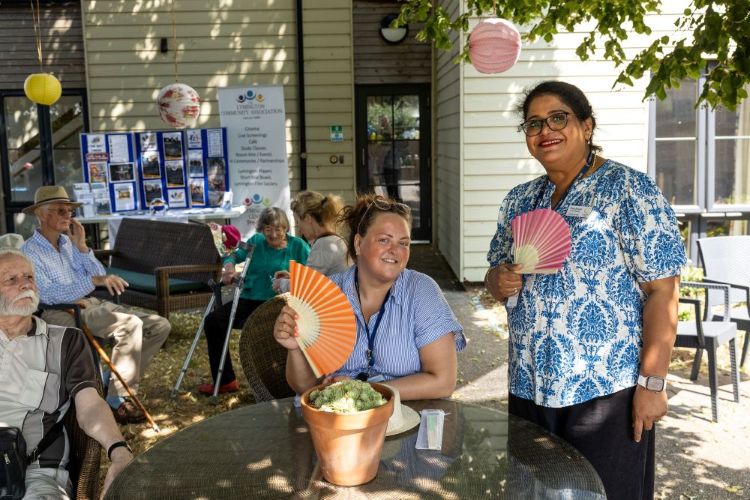
Dementia-friendly festival is part of a wider initiative for dementia care in the community
|

|

Initiated nationwide by the Alzheimer’s Society and supported locally in Lymington by Lymington Dementia Action Group
There are 850,000 people in the UK who are affected by dementia - for which there is still no cure. This does not just affect the elderly: 40,000 people in the UK under the age of 65 suffer from early onset dementia. It is believed that by 2051 the number of people who have dementia in the UK will have risen to 2 million (stats from Alzheimer’s Society).
If you want to understand more about the different types of dementia, of which Alzheimer’s is by far the most common, this article on the Alzheimer's Society website will help.
Awful loneliness and isolation can descend not only on the person with dementia but also on the “carer” – think of the long term husband or wife who is effectively losing the company of his or her partner and at the same time losing their friends who don’t know what to say or do... so they kind of disappear. Think of the previously happy social life, like the regular bridge sessions, gone - they have to leave as the person with dementia becomes increasingly confused. The kind company of others can become something desperately wished for.
Previously known as Dementia Awareness Week, Dementia Action Week takes place across the whole country from 20 to 26 May. The goal of Dementia Action Week is to encourage people to do more than just be dementia aware. Everybody is being asked to take tangible “action” to improve the lives of those affected by dementia, with the ultimate aim to create a dementia-friendly UK in which people with dementia do not feel excluded.
In fact, during this Dementia Action Week, Alzheimer’s Society is encouraging everyone to take action by starting a conversation.
Whether it’s calling a relative with dementia or visiting a neighbour, it’s time to start talking.
 Use the hashtag #askusanything
Many of us worry about ‘saying the wrong thing' to someone with dementia, yet a friendly face or listening ear can make the world of difference. And as you'll see, especially from the children who seem to know this naturally, there aren't many things you can't ask a person with dementia.
So right now start using the hashtag #askusanything!
We are proposing that everybody joins and commits to takes one tangible “action” each day this week to help people with dementia and their carers.
If you follow all or even some of these suggestions, by the end of the week we hope you will have the confidence to start a conversation with somebody who has dementia.
All it takes is a conversation..
A child sees the person for who they are. Watch what happens when children interview people with dementia.
 Tuesday – Seek information!
Call in at one of the two information points in Lymington especially set up for Dementia Action Week.
These are at Lymington Community Centre (just inside the main entrance) and Lymington Library, with volunteers from the Lymington Dementia Action Group present most mornings and afternoons to answer questions and help you find the information you need.
Or if that won’t work for you please click this link to our newly updated online “Dementia Directory” for Lymington – and think whether you know anybody for whom this list of contacts might be useful.
 Music is incredibly beneficial for many people with dementia, both listening to it and taking part in it. And especially singing! And even more so as part of a group. And more so again with purpose – the performance!
For everybody who's been watching My Dementia Choir with Vicky McClure on TV, the fact that so many younger people also have dementia will have become very apparent.
If you haven't already seen it do watch the two moving episodes of My Dementia Choir:
Watch Part One of Two of My Dementia Choir with Vicky McClure
Watch Part Two of Two of My Dementia Choir with Vicky McClure
And also, watch Vicky McClure talking about why the choir
 Thursday: Listen to New Forest Hospital Radio
 Who has actually listened to New Forest Hospital Radio, provided by the wonderful volunteers who make this fabulous facility happen, daily?
If you look at their website you’ll see also a link to the current week’s programme guide which is displayed helpfully in full.
And then remember My Dementia Choir.
This radio station plays the kind of music people with dementia will recognise and relate to from their memories of long ago, the songs to which they may well know all the words too.
Listen to it online, download podcasts. And most of all - spread the word!
 Friday: Check out the activities available locally for people with dementia
 Now check out the regular activities available locally for people with dementia, including the music group “Together in Harmony” with music therapist Frances Attwood – and spread the word about those too!
Book now to attend one of the three upcoming one hour Dementia Friends sessions at Linden House, New Street on 30 May, 27 June or 25 July. This will be run by Dementia Champion and Admiral Nurse Tracy Logan
This is a really quick and rewarding way to gain a better understanding of what it's like to have dementia. One hour spent gaining this knowledge can give you the confidence to start a conversation with somebody with dementia, which in turn has the potential to bring some joy to their day - a small investment indeed.
Sessions take place monthly at Linden House, New Street, Lymington on the last Thursday of the month thus: 30 May, 27 June and 25 July are the next 3 dates, 6pm start.

It can be difficult to know what to say. But Alzheimer’s Society teamed up with people affected by dementia to give you the best tips for getting a conversation started:
If you’re still unsure on how to get the conversation started, Alzheimer's Association can help. Read their Ask Us Anything booklet for more tips and advice. You don’t have to be nervous saying the wrong thing either - there are tips on what not to say to someone with dementia on their blog.
Even in the later stages of dementia when having a conversation might become difficult, keeping in touch means a lot. Seeing friends and loved ones brings feelings of happiness and comfort, and the ‘emotional memory’ remains with people living with dementia long after the memory of the visit may have gone.
Please see also Dementia Action Week in the Events Calendar
Contact Lymington Dementia Action Group if you can help with the mission to make Lymington ever more dementia friendly.

The goal of Dementia Action Week is to encourage people to do more than just be dementia aware. Everybody is being asked to take tangible “action” to improve the lives of those affected by dementia, with the ultimate aim to create a dementia-friendly UK in which people with dementia do not feel excluded.
This year especially, Dementia Action Week is about taking action to improve the social care system. Coronavirus has exposed the fact that families facing dementia have been failed by a social care system that is inadequate, hard to access, costly and unfair. People with dementia have been worst hit by the pandemic, accounting for a quarter of all coronavirus deaths in the UK.
There are 850,000 people in the UK who are affected by dementia - for which there is still no cure. This does not just affect the elderly: 40,000 people in the UK under the age of 65 suffer from early-onset dementia. It is believed that by 2051 the number of people who have dementia in the UK will have risen to 2 million (stats from Alzheimer’s Society).
If you want to understand more about the different types of dementia, of which Alzheimer’s is by far the most common, this article on the Alzheimer's Society website will help.
Awful loneliness and isolation can descend not only on the person with dementia but also on the “carer” – think of the long term husband or wife who is effectively losing the company of his or her partner and at the same time losing their friends who don’t know what to say or do... so they kind of disappear. Think of the previously happy social life, like the regular bridge sessions, gone - they have to leave as the person with dementia becomes increasingly confused. The kind company of others can become something desperately wished for.
Whether it’s calling a relative with dementia or visiting a neighbour, it’s time to start talking. And there are activities and other actions which can help.

Hot off the press, this is exciting news of a 14 week course for people with early stage dementia,starting on Tuesday 6th July.
It will be run at the Coates Centre by Memory Works (click link to their website)
We shall bring more information on this in due course but meanwhile, if you'd like to know more now please contact Memory Works via their website or call Elena on 07590 503210.
Annabel Collenette reports that she will be restarting her art group in Milford on Monday 6th September all being well. She hopes to start again in Lymington too.
For further information regarding the Art Groups contact Annabel Collenette on 01590 679838 or
Contact Gilda Newsham on 01425 473777 for Ringwood. All places have to be booked; Art Dementia New Forest is a Registered Charity No 1178609.
Jane Ward of Dementia Friendly Hampshire reports: "As part of Dementia Action Week next week I would normally be found out and about in various parts of the county with my banner and a bag full of leaflets trying to connect with as many people affected by dementia as possible to help link with information and support, to chat about what they feel would make the best dementia friendly community for them and what we are doing to change things. Obviously this is still not really possible, even though we can go out more and even more venues will open up next week, it would be irresponsible to encourage the extra contact a normal Action Week would involve, so I am attempting to move these sessions online. I have set up several zoom sessions throughout the week where I will be online for an hour and anyone can join me for a chat in much the same way they could if they met me at the local shopping mall. There is no need to book, and I will not collect any personal data. If they wish to join without video that is fine too.
The sessions are listed below with the links. I would be grateful if you could share these with anyone who may be interested in dropping in for a chat.
Tuesday, May 18⋅12:30 – 1:30pm
Join Zoom Meeting
https://us02web.zoom.us/j/81268762987?pwd=WkZPSEJyOTRBSysyT2NIeXhDQVZlZz09
Meeting ID: 812 6876 2987
Passcode: 866981
Thursday, May 20⋅3:30 – 4:30pm
Location:
https://us02web.zoom.us/j/83674086405?pwd=bnRvY1NGSlBDTnVRdlNEaytMbEhtdz09
Join Zoom Meeting https://us02web.zoom.us/j/83674086405?pwd=bnRvY1NGSlBDTnVRdlNEaytMbEhtdz09 Meeting ID: 836 7408 6405 Passcode: 881515
Friday, May 21⋅11:30am – 12:30pm
Location:
https://us02web.zoom.us/j/87587693350?pwd=WUtzY3N2V2N0TmNqNkFJYVBpVXkzQT09
Join Zoom Meeting https://us02web.zoom.us/j/87587693350?pwd=WUtzY3N2V2N0TmNqNkFJYVBpVXkzQT09 Meeting ID: 875 8769 3350 Passcode: 007850
This award-winning charity helps improve the lives of over 18,000 older people across the UK every day. As the only national care provider to offer connected care and support through specialist care homes, thriving retirement living and vibrant community groups, our organisation is a leading light in later life care.
Katie Rickman of MHA says:
We are celebrating this year’s Dementia Awareness week with an Open Day at the Ringwood Community Allotment on Wednesday 19th May.
Bookings can be made via email to
MHA Communities New Forest www.mha.org.uk
Tel: 01425 476142
Mobile: 07483 112138

This information has been prepared by Lymington Dementia Action Group to help those affected by dementia in the Lymington and New Forest area. Please use the links provided, for more detailed information as relevant. There are also Dementia Information Points where you can find printed copies of this information: in local GP surgeries, Lymington New Forest Hospital, Waitrose, Tesco, St Barbe Museum & Art Gallery, and Lymington Community Centre.
Lymington Dementia Action Group is a local group of volunteers which can provide access to advice, support, companionship and activities, for people with dementia and their carers. If you would like someone to assist you to find the information you need please email in the first instance:
Alzheimer’s Society, national and local advice and information, www.alzheimers.org.uk ‘The Dementia Guide’, ‘Caring for a person with dementia’, basic guides by Alzheimer’s Society The dementia support worker for the New Forest area is Carol Whittaker:
Andover Mind Hampshire County Council's carer support and dementia advice service: 01264 332297 or email:
Dementia UK Admiral Nurses, advice, information and support: www.dementiauk.org
National Helpline 0800 888 6678 www.dementiauk.org/get-support/admiral-nursing
Dementia Friendly Hampshire an independent charity working to make Hampshire a county where people affected by dementia can live a good life: www.dementiafriendlyhampshire.org.uk
Dementia Support Hampshire and Isle of Wight Supporting local people living with dementia: www.mydementiasupport.org
Dr Jennifer Bute, former GP who herself has dementia, www.gloriousopportunity.org/ very practical tips on how to live with dementia, ‘Dementia from the Inside’ book with Louise Morse
Lymington.com for information on local events and links to help and support: www.lymington.com
Silverlinks, free home visits for information and advice to older people: contact Celia on 07825 168364
HOPe (Helping Older People New Forest) help with benefits, money, advice, consumer advice, care at home, all services for older people: www.hopenewforest.org 9 Mallard Buildings, Station Road, New Milton, BH25 6HY 01425 629009
Lymington Dementia Action Group, a group of volunteers who signpost and organise local events, contact Lindsay at
New Forest Disability Information Service, information and advice to those of any age affected by disability, www.newforestdis.org.uk, 01425 628750
Citizens Advice Bureau Local office in Lymington Town Hall www.newforestcab.org.uk 0808 278 7860
Attendance allowance, Department of Work and Pensions, help with care: www.gov.uk/attendance-allowance
Eligibility for 25% reduction in Council Tax, eligibility for discount with a diagnosis of dementia: New Forest District Council, www.newforest.gov.uk/article/530/Council-Tax-Discounts 02380 285000
Age Concern New Forest, independent local charity providing support for older people, their families and carers: 02380 841199 www.ageconcernnewforest.org.uk
Allied Services Trust, Deborah Pardoe, an affordable charity assisting with planning, provision and preparation for possible mental incapacity, wills and power of attorney, www.alliedservicestrust.org
Coates Centre Dementia Support Group, Informal coffee mornings 10.30 Thursday mornings, The Oakhaven Wellbeing Centre in the Coates Centre, Oakhaven Hospice, Lower Pennington Lane, SO41 8ZZ contact Cynthia on 07894 050864
Dementia Support and Activities Group Tuesday mornings 9.30 – 12.30 United Reform Church, Lymington High Street contact Cheryl on 01590 671085
Dementia Adventure, respite holidays for people with dementia and carers, dementiaadventure.co.uk
Art Dementia New Forest, painting with support and help, Annabel, 01590 679838 or 07855 985375,
spudWORKS Arts and education charity Station Road, Sway SO41 6BA 01590 682260
hART (Hampshire Art for Recreation and Therapy), creative therapeutic and recreational activities to support mental health and well-being, www.hart.works 07999 492808
Coda Music and Arts Trust offering creative activities to support mental health and well being.
01425 276161 www.coda.org.uk
Memoryworks Cognitive stimulation therapy www.memoryworks.org.uk
contact Elena Prieto-Ruiz on 07590 503210
New Forest Live at Home events, activities and outings to enable older people to maintain their independence and live more fulfilled lives: 07843 112138
Care Navigators Supporting those aged 65+ based at each doctor’s surgery
Princess Royal Trust for Carers Information and advice for carers including setting up an emergency care plan https://carercentre.com 01264 835246
Hampshire Adult Services, www.hants.gov.uk/socialcareandhealth/adultsocialcare/contact
Practical support
Blue Lamp Trust, Bobby Scheme, free home security visits, smoke alarms and advice, www.bluelamptrust.org.uk
TIB Services, retired police officers undertaking decorating, disabled adaptations and general indoor and outdoor maintenance tasks, 0800 2550255
Take a Break for carers, up to 3 hours a week care relief, accessed through adult services:
www.hants.gov.uk/socialcareandhealth/adultsocialcare/respite-break
Day Care Respite, following assessment by Hampshire adult services: www.hants.gov.uk/socialcareandhealth/adultsocialcare Solent Mead, Lymington 01590 674687 or self-funding, Osborne Lodge, New Milton, 01425 618248 Gore Grange, New Milton,
Message in a bottle, keep personal and medical details on a standard form and in a common location for emergency services, free bottle supplied from doctors, pharmacies.
‘This is me’, a way of letting medical and social care staff know more about the person who has dementia, free forms available from Alzheimer’s Society.
Herbert Protocol, form used to find missing persons (best completed in advance!) hantsar.org/herbert-protocol/
Emergency Care Plan from Princess Royal Trust for Carers (see above)
Please help us to keep this page up to date by letting us know if you discover information to be incorrect: email

I have written on these pages before about my own mother and last month the final stage of Alzheimer’s finally ended for her after 14 years - despite a doctor friend’s long ago prognosis that once diagnosed she would live for a maximum of 3 years longer.
For reasons we cannot fathom, her will to live was stronger than the disease, but my personal theory is that she was at some level enjoying not just the comfy bed (she always loved a lie in) but much more importantly the cosseting and caring of all the many wonderful people who looked after her over the total of 6 years living in a Colten Care specialist dementia care home.
Immediately after my mother drew her last breath a few short weeks ago, her face seemed to relax as though finally she had been released.
In the following days my sisters and I were flooded with beautiful words sent in texts, emails, letters and cards by family and friends from near and far. All the messages contained similar themes and words such as: “She was a such a very proper lady and the sort they don’t make any more. Always elegant and graceful as well as utterly charming.”
And during the preparations for her funeral we pored through photographs of Mum from our growing up days and before, and stirred up many more of our individual memories.
It definitely felt to me as though we had been released as well, freed to remember her again as our beautiful, capable and clever Mum of whom we were always so proud.
As must be the case for so many families when the end comes for a loved one with Alzheimer’s, able once more to remember the real person.
 The final 14 years of Mum’s life were marked by her steady deterioration, through the inexorable stages of the cruel illness of Alzheimer’s. A far cry from the happy, fulfilled nursing sister of her times.
The evidence of short term memory loss began as it often does with repetition of the same question, and looking back on it my own insistence on replying with “Mum you just said that” reminds me of just how ignorant I was then.
As her confusion increased she learned techniques to pretend she was ok. For a while she could fool a lot of people. But eventually the pleasures she and my father had lately enjoyed like playing bridge became challenging, he grew more isolated and lonely, she more frustrated, and everything harder for us all - both to understand and to know what to do for the best. Even long after diagnosis it was also difficult to find tangible advice or support for Dad who by this time was doing everything he could independently to keep Mum safe, clean and fed, but in the process I am convinced hastening his own death.
Eventually, thanks to Colten Care, we found Mum a really top quality specialist dementia care home: first in Winchester and then in Lymington.
Thanks to our parents’ lifelong habits of saving and thrift this was affordable. And there she was cosseted and cocooned by the most amazingly compassionate and understanding team of people you could ever hope to find. And immediately she seemed to be more relaxed, almost happy at times.
They love their residents almost as their own family, calming their confusions, helping them to feel more “normal” in their prisons in their brains.

In the middle stages of Alzheimer’s the person often believes him or herself to be living back in his or her younger life. And by this time Mum was spending a lot of time in an imaginary world of her own which frequently included her own parents and other names we didn’t recognise.
In a good dementia care home the wonderful carers know how to communicate in the moment. They understand how to talk and behave as if they are right inside the imagined lives. Those lives are real to those who are living them. It can get confusing for anybody. But that ability provides reassurance and instils calm.
In fact we were fortunate that Mum was relatively easy to care for, she never became aggressive as some do with Alzheimer’s. Just occasional expletives were uttered, which rather amusingly included words she’d never allow us to say when growing up and in fact, we were surprised that she even knew some of them.
In the main and to the end she managed to remain her dignified and well mannered self.
And there were some upsides for Mum too: for example she always loved her bed. Throughout her married life Dad would have her rising way too early for her natural flow. In her final years she could lie in - her watchful carers could see she needed a little longer. And whilst physically she always remained well, gradually she became too tired to benefit from being hoisted into her chair and into the lounge. So then she would more frequently spend whole days in her peaceful airy room with her favourite music playing, visited often by the carers and tended to with great tenderness.
 In the end our mum slipped peacefully away over a period of a few days. This was in no small way attributable to the constant skill and attention of the wonderful team of nurses and carers.
I must stress however that the staff were also ready for all eventualities including the possibility as happens in some cases, where the final stage includes physical distress.
At Mum’s funeral I thanked and want to mention again by name here: Bella, Anna, Kirsty and Chelsea, all of whom attended from Linden House, and asked them to go back and tell the rest of the wonderful team how much we appreciated every single one of them.
I believe it’s because of these people that Mum didn’t want to let go of life, rather wanted to hang on and get every last drop of it. We have rarely heard of anyone else who lived so long with Alzheimer’s.
Belatedly, after the funeral, I realised how little we consider the perspective of the funeral directors, given that mostly from the moment we make contact with them we're also dealing with grief and emotion.
The National Association of Funeral Directors says: "The role of a funeral director is a broad service encompassing practical organisation, support and guidance to the family and liaison with a wide range of other organisations and services to ensure the funeral is properly arranged."
But that simply does not do justice to the breadth and depth of the skills needed by a good funeral director. And in that context I'd like finally to pay tribute too to Nigel and Veronica at FW House & Sons, independent and brilliant Lymington funeral directors who are not only deeply experienced and professional but also the most compassionate and caring people one could ever hope to find, always with a way of seeing the humorous side too which is absolutely vital.

Prompted by Dad’s suffering much later on I became a member of the then newly forming Dementia Action group here in Lymington, one of many volunteer groups around the country which tries to promote Dementia Friendly behaviour in the community as well as providing information, support and even fun, for people with dementia and their carers.
Other than my experience of and recommendations for Linden House, these are the key things I have learned
1. People with Alzheimer’s are ill. It’s just a strange kind of illness which takes place mostly inside their heads, and they are confused and frightened by all sorts of everyday things we can’t see or feel. If they’re alone they may even be lost. We should try not to turn away, everything kind we can contribute will help.
2. We shouldn’t question or challenge what the person says (especially not like me at the beginning with “mum you just said that”) – we should try and climb in there in our heads, join their story and go with their flow.
3. We should all try really hard to do that whenever we get the opportunity, anywhere, ever. It all helps that person feel a little bit better.
If you are moved by this article to get involved with Lymington Dementia Action Group or to contact Colten Care you are welcome to do so via
Thank you for reading this personal story.
Many families are affected by dementia. The condition is set to become the biggest killer of the 21st century - someone develops dementia every three minutes, and too many are facing it alone without adequate support. Here are some facts and figures about dementia:
1. Dementia is an umbrella term
Dementia describes different brain disorders that trigger a loss of brain function. These conditions are all usually progressive and eventually severe. Alzheimer's disease is the most common type of dementia, affecting 62 per cent of those diagnosed. Other types of dementia include; vascular dementia affecting 17 per cent of those diagnosed, mixed dementia affecting 10 per cent of those diagnosed, frontotemporal dementia and dementia with Lewy bodies.
Symptoms of dementia include memory loss, confusion and problems with speech and understanding. Dementia is a terminal condition.
Dementia doesn’t care who you are and can affect anyone. It’s caused by diseases of the brain which includes Alzheimer’s disease. Dementia affects everyone differently. Someone with the condition might experience a number of changes including problems with memory, thinking, concentration and language. It mainly affects people over the age of 65 however there are more than 42,000 people under 65 living with dementia in the UK.
Dementia is progressive, meaning that symptoms gradually get worse. However, many people living with dementia lead active and fulfilling lives for many years. There are many ways to help support someone living with dementia from becoming a Dementia Friend, gaining a better understanding of the condition, to volunteering with Alzheimer’s Society’s Side by Side service. The charity is for everyone affected by dementia, to find out more about local services or volunteering visit alzheimers.org.uk
There are 850,000 people in the UK who have a form of dementia, of which an estimated 3,800 live in the New Forest, 19,000 in Hampshire. Dementia has replaced heart diseases as the leading cause of death in England and Wales, accounting for 11.6% of all deaths registered in 2015, according to the Office for National Statistics. Dementia is set to be the 21st century’s biggest killer, with someone developing it every three minutes.
Only around 50% of those with dementia in Hampshire have been diagnosed - so there are lots of people with dementia who are not getting support and treatment that could help them and their families.
Delaying the onset of dementia by five years would halve the number of deaths from the condition, saving 30,000 lives a year. Of the top 10 causes of death, dementia is the only one we can’t prevent, cure or even slow down, but funding of dementia research is still far too low. Research is continuing into new drugs, vaccines and other medical treatments. Drugs do exist for Alzheimer’s disease which can improve symptoms or temporarily slow progression, in some people. There are no licensed drug treatments for other forms of dementia.
Dementia research is desperately underfunded. For every person living with dementia, the annual cost to the UK economy is over £30,000 and yet only £90 is spent on dementia research each year.
Alzheimer’s Society is committed to spending at least £150 million over the next decade on dementia research including a £50 million investment in the UK’s first dedicated Dementia Research Institute.
Alzheimer’s Society provides information and support, improves care, funds research, and creates lasting change for people affected by dementia. The charity is investing in research into dementia care, cause, cure and prevention of all types of dementia. Dementia devastates lives. The Alzheimer’s Society needs people to unite against dementia now. Whether you choose to donate, volunteer or campaign, every action makes a difference.

The Arts Groups which the Alzheimer’s Society started in 2007 are based in Milford on Sea, Lymington and Ringwood. They have been an amazing success and give tremendous pleasure not only to the artists but also their families, friends and all concerned. The production of cards, calendars and art exhibitions has sent out some positive messages that there is a life after diagnosis of dementia and that life-long learning, well-being and inclusion is all important.
Art and culture holds a unique place in our lives. Whether it's singing, poetry, museums or dance, they enrich our lives and bring pleasure to everybody at some point. This is no different for people with dementia and researchers have therefore begun to develop an increasing interest in the arts, aiming to find evidence as to how and why they may be able to help people with dementia.
Art Dementia New Forest is a new charity who have now taken over the local art groups, constituted under the “small charities commission.” The charity is going from strength to strength and wants people with dementia to be part of an art group just like anyone else.
Fortunate in being able to participate in the New Forest Show, in 2016 two of the artists were awarded a bronze and silver medal for their superb paintings.
Fundraising by Art Dementia New Forest will be continuous and any help would be welcomed. The charity aims to keep the highest quality standards and it is of the utmost importance that these are maintained. If anyone would like to consider volunteering - a rewarding and fun thing to do, do get in touch.
For more information about the Art Groups, please contact Gilda Newsham MBE, Secretary, Art Dementia New Forest on 01425 473777.
Useful starting points
Alzheimer’s Society, national and local advice and information, www.alzheimers.org.uk ‘The Dementia Guide’, ‘Caring for a person with dementia’, basic guides by Alzheimer’s Society
National Dementia Helpline 0300 2221122 Vivien Walker New Forest Dementia Adviser 07484 092551
Dementia UK Admiral Nurses, advice, information and support. National Helpline 0800 888 6678 www.dementiauk.org/get-support/admiral-nursing Tracy Logan, based at Linden House, New Street, Lymington
Dr Jennifer Bute, former GP who herself has dementia, www.gloriousopportunity.org/ very practical tips on how to live with dementia, ‘Dementia from the Inside’ book with Louise Morse
Becton Centre, Barton-on-Sea, BH25 7AE 01425 623802 Community Mental Health Centre, assessment and treatment for symptoms of dementia. Normally referred by GP, however you may self-refer. If dementia is diagnosed, a care plan is drawn up and a referral made to free Memory Matters course. Lymington.com, local events www.lymington.com/dementia
Advice and guidance
Dementia Advisor Service, from diagnosis throughout your journey with dementia, 023 9289 2034,
Connect to Support Hampshire, www.ConnectToSupportHampshire.org.uk
Silverlinks, free home visits for information and advice to older people, 07825 168364
Dementia Friendly Communities, Jane Ward, information about local services, dementiaroadmap.info/westhampshire
Helping Older People New Forest, charity shop, information and advice including basic financial advice, 9 Mallard Buildings, Station Road, New Milton, BH25 6HY 01425 629009
Lymington Dementia Action Group, a group of volunteers who signpost and organise local events,
Dementia Information Points, flyers about local events, groups, in surgeries, Lymington New Forest Hospital, Waitrose, Tesco, Lymington Centre
New Forest Disability Information Service, information and advice to those of any age affected by disability, www.newforestdis.org.uk, 01425 628750
Legal and financial
Attendance allowance, Department of Work and Pensions, helps pay for care if you are over 65 and need help with personal care, www.gov.uk/attendance-allowance
Eligibility for 25% reduction in Council Tax, New Forest District Council, www.newforest.gov.uk/article/530/Council-Tax-Discounts for people with a diagnosis of dementia and at least one other qualifying benefit 02380 285000
Citizens Advice New Forest, free information and advice on a wide range of problems, Court Mews, 28a New Street, Lymington, SO41 9BQ. https://newforestcab.org.uk/contact-us/lymington/ 0300 3309 009
Age Concern New Forest, practical information on health, housing, home security, benefits, pensions, support and advocacy in approaching other agencies, including Social Services, New Forest District Council, The Pension Service and the Health Service, and a number of support services,02380 841199 ageconcernnfe.btck.co.uk/
Allied Services Trust, Deborah Pardoe, an affordable charity assisting with planning, provision and preparation for possible mental incapacity, wills and power of attorney, www.alliedservicestrust.org
SSAFA (Soldiers, Sailors, Airmen and Families Association), charity provides support to veterans from the British Armed Forces and their families or dependents, www.ssafa.org.uk
Beneficial activities and therapy
Coates Centre Dementia Support Group, 01590 677198, The Hub, Lower Pennington Lane, SO41 8ZZ
Informal coffee mornings 1st and 3rd Tuesday of each month 10.30 – 12noon
Dementia Adventure, respite holidays for people with dementia and carers, dementiaadventure.co.uk
Mind for you, supported holidays, http://www.mindforyou.co.uk/
Anything grows, dementia friendly allotments, Becton Lane Allotment Site, New Milton BH25 7DL, Tuesdays 10 – 1, Thursdays 1 – 4, Susan Wiffen 07884 300641
Art Dementia New Forest, painting with support and help, Annabel Collenette, 01590 679838, mobile 07855 985375,
Together in Harmony, active music-making for people with dementia and carers, Frances Attwood, 01590 718749, mobile 07500 117814,
hART (Hampshire Art for Recreation and Therapy), creative therapeutic and recreational activities to support mental health and well-being, https://www.hart.works/ 01590 435045
Memoryworks, Elena Prieto-Ruiz, cognitive stimulation therapy 023 8028 6342, www.memoryworks.org.uk Fenwick Health and Well-being Centre, Pike Hill, Lyndhurst, SO43 7NG
New Forest Live at Home, Katie Rickman, events and outings, 07843 112138
Health
Care Navigators Supporting those aged 65+ based at each doctor’s surgery
Princess Royal Trust for Carers, information and advice for carers, setting up emergency care plan. Mondays and Tuesday between 10am and 4pm - 0808 808 7777 www.carersuk.org/help-and-advice/talk-to-us
Lymington Care Group, volunteer transport for medical appointments, 01590 679187 www.lymington.com/lymington-voluntary-care-group
Hampshire Adult Services, www.hants.gov.uk/socialcareandhealth/adultsocialcare/contact connecttosupporthampshire
Practical support
Blue Lamp Trust, Bobby Scheme, free home security visits, smoke alarms and advice, www.bluelamptrust.org.uk
Trust in Blue, retired police officers undertaking decorating, disabled adaptations and general indoor and outdoor maintenance tasks, 0800 225 0225
Take a Break for carers, up to 3 hours a week care relief, accessed through adult services https://www.hants.gov.uk/socialcareandhealth/adultsocialcare/supportforcarers/respitebreak
Day Care Respite, following assessment by Hampshire adult services, Solent Mead, Lymington 01590 674687 or self-funding, Hartwood House, Lyndhurst 023 8028 4555, Osborne Lodge, New Milton, 01425 618248 Gore Grange, New Milton,
Message in a bottle, keep personal and medical details on a standard form and in a common location for emergency services, free bottle supplied from doctors, pharmacies.
‘This is me’, a way of letting medical and social care staff know more about the person who has dementia, free forms available from Alzheimer’s Society.
Herbert Protocol, form used to find missing persons (best completed in advance!) hantsar.org/herbert-protocol/
Emergency Care Plan from Princess Royal Trust for Carers (see above)
Trackers and telecare products Dementia Advisor Service (see above) 0345 265 8003
Grocery delivery orders by telephone, 01425 619883, http://www.montanasonlinestore.co.uk/
Lymington Dementia Action Group May 2019

 Lymington Dementia Action Group are currently looking at organising Cage Cricket for people living with dementia.
Cage Cricket allows for everybody, regardless of experience, ability, background or physical condition to take part. The game adapts to those playing, can be played inside or out, and lasts for no longer than an hour. Cage Cricket gives the chance for people to work together, to learn from one another, to help and encourage each other and to create new friendships.
Sessions so far, run in Hampshire and in Surrey, have trailed games solely for those living with dementia, but also games for 50+ which were inclusive of those living with dementia.
Dementia Friendly Hampshire have teamed buddies up with the participants to aid with mobility issues and also as prompts for positioning during play and scoring as required. These buddies also added greatly to the sense of inclusion of the players!
 Another aspect we hope to start exploring this summer is that of teams comprising family members. So often younger members of a family find it difficult to maintain relationships with grandparents when they have dementia, we would hope that pairing grandchildren as buddies for grandparents may provide a valuable new relationship which can be built on for other activities.
For more information and to be kept updated, please get in touch with
Jane Ward from Dementia Friendly Hampshire

Lymington Dementia Action Group http://lymington.com/lymington-dementia-action-group is a local group of volunteers which can provide access to advice, support, companionship and activities, for people with dementia and their carers. If you would like someone to assist you to find the information you need please email or call in the first instance:
Email:
What is dementia?Dementia is not a normal part of ageing, and is not confined to the elderly. The term dementia describes a set of symptoms that occur when the brain is damaged by certain diseases, such as Alzheimers or a series of small strokes.
Everyone’s experience is different, but things to look out for include problems with:
These changes are often small to start with, but gradually they begin to affect daily life and family and friends may start to notice too.

First of all it’s important to rule out other conditions that may have similar symptoms and may be treatable, including depression, dehydration and urinary tract infections, etc. You may be asked to take a short memory test – a series of simple questions. If appropriate your doctor will then refer you to our local specialist dementia centre, the Becton Centre in Barton on Sea. Their specialists and memory nurses will carry out more testing and possibly a scan. Based on results combined with your medical history they will compile and make a diagnosis. You may then be given a prescription for medication, which can slow the progression of the disease. 
First of all, it allows you to take control of the situation rather than letting it control you. And it unlocks the door to legal, social and practical support, which will help you and your loved ones to live well, for longer. The good news is, there are people to help you with every aspect of coping with dementia. You don’t need to feel alone; there is support and help on hand.
Hampshire County Council funds the Dementia Advice Service for our area. When you receive your diagnosis you should be introduced to your local dementia advisor, who will ensure you have all the information you need. Dementia advisors provide one to one support, as confidential as you want it to be. They can arrange to visit you at home or if you prefer you can visit them at the regular local drop in session, where you can keep visiting again for as long as you need and as your needs change. They will also be available on the end of a telephone when you need more help.
Contact your local dementia advisor on 023 9289 2034 or
Subscribe to our weekly email containing the latest news and events in and around Lymington.
