Pony drifts in the New Forest National Park: about the drifts or "round-ups"; 2026 dates, locations to avoid and other useful information.

Locally


Her Royal Highness The Princess Royal visited Royal Lymington Yacht Club on Wednesday 23 September to celebrate the Club’s much-loved Wednesday Junior Sailing programme and mark the Grand Finale of its 2026 season.

The Lymington Maritime Futures Hub is a community-led initiative exploring how Lymington’s historic Drill Hall can be saved, restored and given a purposeful new life. Read on to find out more.
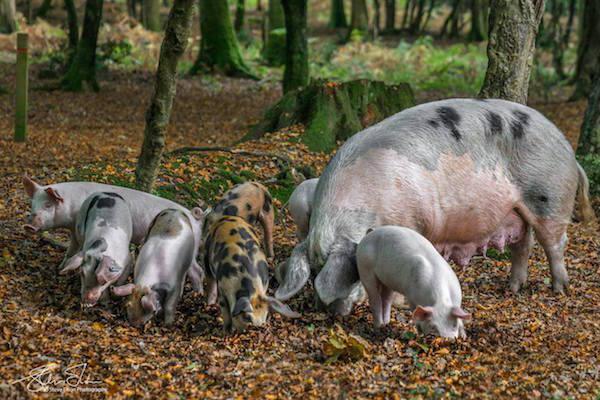
Look out for piggies in the New Forest this autumn!
Pannage season 2026: 14 September to 29 November
The New Forest Pannage Season 2026 runs from Monday 14 September to Sunday 29 November, unless an extension is agreed upon by the Verderers.

It's once again the season of pannage in the New Forest, when pigs are released on the forest to stop the ponies from eating more acorns than are good for them. Living here we become accustomed to these annual forest traditions but you may be interested to know that this year pannage is being being reported and explained in the National Press too!
About the pigs of the New Forest
The pigs of the New Forest play a vital part in the eco-system. Their services are required to eat the acorns which they love and which are safe for them, and to prevent the ponies for whom they are potentially lethal, from doing so.
Read on below to learn all about pannage.
And do also read Mark and Hugh's entertaining article about drifts and pannage. It was written a few years ago now but the traditions of the forest are annual and timeless!
And if you happen to come across some photogenic piggies in your travels do send us your pictures - we'll publish here and credit the photographer!
Sign up for our free Weekly What's On
For lots of local information including interesting articles like this, upcoming events (including many community events which are free or low charge) and special offers, sign up to receive our free weekly e-newsletter!
If you don't already receive it sign up here!
Pigs by the roadside
All about pannage in the New Forest
Every autumn, when the acorns, chestnuts and various other nuts have fallen from their trees, up to 600 domestic pigs (usually owned by commoners) are let out onto the New Forest National Park for up to 60 days, to clear away and eat the nuts. This is called ‘pannage' or ‘common of mast’, and it is important because many of the nuts are poisonous to other animals in the New Forest, such as cattle and ponies.
The New Forest National Park is one of the few places that still carry out the tradition, which dates back to the time of William the Conqueror when they would use up to 6,000 pigs! Nowadays between 200 and 600 pigs are turned out as the number owned by commoners has fallen. The event is a great sight and makes for excellent photos - a walk in the forest to remember.
Commoners pay a token fee for each pig they turn out. Each pig is marked with an identity tag in its ear and has a ring put through its nose which enables it to forage through leafl litter and surface vegetation but stops it from rooting into the ground with its snout which causes damage to the Forest.
The 2026 Pannage Season
Pannage in the New Forest began Monday 15th September and is scheduled to run until Friday 28th November. There is an expected heavy acorn crop this year, the end date could be further extended depending on how the pigs get on with gobbling up the acorns. The Court of Verderers decides these things!
Pigs have right of way on the roads!
Free-ranging pigs have right of way on the roads, just like the ponies, donkeys and cattle on the Forest. The pigs, though domesticated, are not tame and the same respect (probably more so) that you would show to any of the other free-roaming animals should be extended to them. Please do NOT touch or feed the animals.
If you are really lucky during pannage season you may see some of the old English breeds of pig, such as Large White, Tamworth, Berkshire or British Saddleback. During this time of year, you may also find local shops selling pig-shaped chocolates, cakes and biscuits in celebration of this country tradition – for those who like their pigs more sweet than salt.
Find out more about Pannage: https://youtu.be/Cn8ri56LFro or click on the image below which will take you to this short film by the New Forest National Park Authority.


Photos by Steve Elson
It'll soon be late summer in the New Forest, and Careys Manor Hotel & SenSpa invite you to make time for four new experiences: guided walk and tapas, moments in focus photography masterclass, seasonal blooms workshop and a wedding open day.

The Lymington Maritime Futures Hub is a community-led initiative exploring how Lymington’s historic Drill Hall can be saved, restored and given a purposeful new life. Read on to find out more.
Lymington-based, award-winning holiday cottage rental business New Forest Escapes is proud to have been awarded 'B Corp' certification. For what this means and why it's a good thing - read on!Read on!

Dylan James, Head Chef at Careys Manor's renowned Cambium Restaurant in Brockenhurst, is eagerly anticipated this summer's food events in the New Forest, the highlight of which is Lymington Seafood Festival where Careys Manor is a headline sponsor.

Twenty Five magnificent stallions for the New Forest this summer
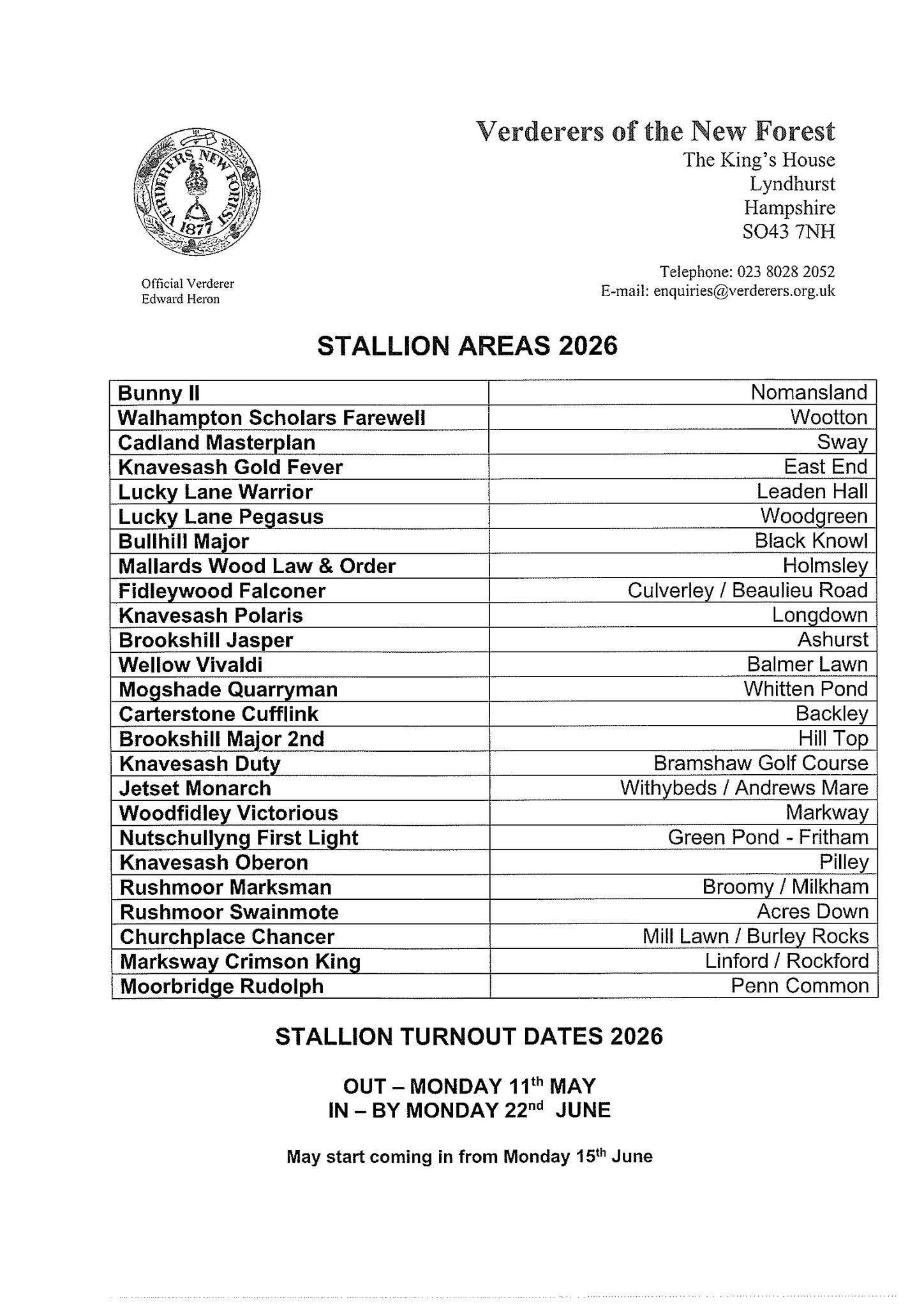
For six weeks beginning Monday 11 May, twenty five magnificent New Forest stallions will be roaming as they will in their designated areas of the forest to ensure the survival and quality of pure-bred New Forest ponies. The stallions are chosen after careful vetting by the New Forest Pony Breeding and Cattle Society and the verderers, who take into consideration qualities such as stamina, hardiness and temperament, which will be passed to the next generation of foals. Read on to see this year's stallions, read their wonderful names and see where they're roaming, and also to re-read Mark and Hugh's fascinating - and timeless - article about this New Forest tradition.

The release of the stallions onto the New Forest for a few weeks in early summer is an annual ritual essential to ensure the continued survival of pure-bred New Forest ponies. This year's stallions are released on Monday 12 May and will be on the forest until Mon 23 June although they may start coming in the week before.
The stallions are chosen after careful vetting by the New Forest Pony Breeding and Cattle Society and the verderers, who take into consideration qualities such as stamina, hardiness and temperament, which will be passed to the next generation of foals. They are only allowed on the Forest for a few weeks to limit the number of foals born each year. Considerations include trying to predict the demand and market for foals a year or so ahead, as well as the numbers needed as replacement breeding stock so commoners can maintain their herds, and ensuring enough stallions of different blood lines to maintain a diverse gene pool for the breed. Before the current scheme was introduced up to 100 stallions ran on the Forest year round, with foals sometimes only fetching a few pounds at auction.
Members of the public are urged to avoid getting too close to ponies during stallion season, due to the tendency for frisky and unpredictable behaviour. And to keep dogs under close control and, unless they have 100% reliable recall, on a short lead.
Verderers' also particularly advise horse riders to avoid stallion areas. "Any equine entering their area will inevitably result in the stallion approaching to check if the newcomer is a threat to his herd, or should be encouraged to join it. An entirely natural reaction, which can be intimidating to all but the most confident riders."
If you don't already receive our weekly e-newsletter full of useful local information and news told with a personal twist do sign up for it here - and then read on!
Stallions and Turn Out Areas May-June 2025
More details about the stallion selection process:
The stallions are inspected by judges, who assess their suitability for breeding based on their physical characteristics and temperament.
-
- Breed Management:
- The New Forest Pony Breeders and Cattle Society, along with the Verderers, play a key role in managing the stallion population and the breeding process.
- HLS Funding:
- The New Forest Higher Level Stewardship scheme provides funding to support the grazing of stallions, which helps maintain the breed's genetic diversity.
- Turn Out Areas:
- The Verderers of the New Forest provide a list of specific areas where stallions will be turned out for breeding, ensuring that they are spread across different parts of the forest.
- Foal Production:
- The goal is to produce a sufficient number of foals each year to prevent the breed from dwindling, while also maintaining the natural ecology of the forest.
With thanks to New Forest Pony Stallions and New Forest Verderers for information and photographs.
The annual workload of the carefully selected stallions of the New Forest, concentrated into just a few weeks each summer, ensures the continuation of this vital element of New Forest life

A couple of years ago our erstwhile cartoonist Hugh and editor Mark (who've gone on to other things and we now fondly miss) took a serious whilst entertaining look at this aspect of New Forest life about which many will know a little but most not a lot. Their research including the help they received from our wonderful agisters will enlighten if you read on.
So now with Mark...
"Recently I read in this august organ about the release of the stallions, an annual event which, up until a short time ago, was a complete mystery to your clueless scribbler. This raised so many questions in my tiny mind that I simply had to find the answers. So, if you want to learn yet another aspect of how this enormous and beautiful area is managed, read on. But first some equine guidance for those that need it (me), these are the modern names for the different ages and sexes of ponies.
Terminology
- FILLY. A female horse or pony under four.
- COLT. A male horse or pony under four (not gelded).
- FOAL. A female or male horse or pony under one. Sometimes referred to as filly foal or colt foal.
- YEARLING. Female or male between one and two. Sometimes referred to yearling filly or yearling colt (not gelded).
- MARE. Female horse or pony four years or older.
- STALLION. Male horse or pony four years or older (not gelded).
- GELDING. A male horse or pony that has been castrated (gelded).
The original cordless lawnmower
 The New Forest pony has been around for a while along with the commoners who both live in and manage the Forest. In life our mistakes and the lessons learned from them are generally referred to as experience and managing the Forest is a craft that has been honed over many years through just this; it’s a truly multi-faceted organism. It seems to me that the more research I do and the more I discover about the Forest, the less I seem to know.
Through hard won experience the Verderers, Agisters and Commoners have learned how to manage this huge natural area which we are so fortunate to have on our doorstep. New Forest ponies clip the grass, prune gorse and, as described in a previous article, even eat holly leaves. I know! For this they ask for no payment, they certainly don’t need our doughnuts, apples or carrots; they’re more than capable of nourishing themselves. But here’s the question, how many ponies can the forest support, how much natural food is out there? When is the best time for foals to be born? The commoners know the answers; they also have a clever system.
A few busy weeks, this year, eight busy weeks
 Stallions, (males which are entire and capable of breeding), are kept in paddocks away from the mares (females) for all but a few shohrt weeks of the year. During this period in May and June the stallions are set free in order to do what comes naturally; this year it will be for eight weeks. This ensures that the desired number of foals will be born eleven months later in early spring when the weather is kind and there is fresh spring grass for them to eat. Hugh tells me that a foal born in winter would be lucky to survive.
The Verderers limit the number of stallions released onto the Forest to breed. This year, out of a stock of just over thirty breeding stallions, twenty were released. This number is reassessed each year depending on the pony population.
Those lucky few
Fillies are allowed to enjoy the forest as nature intended but for the colts it’s a different matter. Before they are two years old they undergo a detailed inspection by Verderers and only certain selected colts will be allowed to become part of the breeding stock. As you will have gathered by now, the vast majority of colts are gelded which is a polite term (sensitive male readers should look away now) for castration. Geldings then have complete freedom of the Forest for the rest of their days. By contrast the stallions can look forward to forty-eight weeks of isolation in a paddock. They’re well fed but the scenery stays the same.
If you thought they were frisky before
 When the stallions are released from captivity the behaviour of the ponies changes completely. The mares and fillies flirt outrageously with the stallions; there is a buzz in the air and this annual mating ritual has a huge effect on the herds. As far as we visitors are concerned, we would be crackers to get too close to ponies at this time of year. Never has the telephoto lens and binocular been so useful. Geldings retain a great deal of their competitive nature and will fight with stallions for a favourite, often winning the contest. In general ponies are fizzing with excitement and for this short period we two legged ones should stay well away. I’m told that the risk of a pony running into the road increases too so when driving we need to be even more cautious.
Those fortunate enough to be able to ride in the Forest have to be even more careful. Jonathan Gerrelli who is the Chief Agister recommends that riders use caution at this time of year. Upon seeing an approaching horse a stallion might either see it as a threat and chase it away or see it as part of its herd and try to round it up. He suggests that riders might change their route or, perhaps, not ride.
‘Time for bed’ said Zebedee
I was curious as to how on earth you went about finding just twenty stallions in such a vast area, so I spoke to two agisters, Mike Lovell and Andrew Napthine. Apparently the stallions are released into pre-arranged specific areas and tend not to roam far; but then I suppose they’re rather pre-occupied. I also asked how they are brought back in to the paddocks; visions of lariats, campfires, coffee and beans. I imagined that they might be reluctant to return to the imprisonment of a paddock. This is not the case at all and in most cases the stallions are spent; there’s an air of ‘thank goodness that’s over’. If anything, they welcome the opportunity for rest and in most cases the owner can simply walk up to them with a halter in one hand and a bucket of food in the other. I can just imagine the stallion whispering to the owner ‘can I go home now please?’. These days the stallions are halter broken and will ‘come along quietly’ as it were. Mike tells that back in the day when the stallions were unbroken they had to be rounded up on horseback, drift style. Exciting and, I suspect, rather dangerous.
NB To see the names of this year's stallions and their areas click this link
On a personal note
I have always loved the Forest with its sheer sense of space and the peace and quiet that can easily be found. In carrying out research for these articles I have learned so much more about the flora and fauna and as a result I’m enjoying it even more, I sincerely hope it’s the same for you. Our thanks to Jonathan Gerrelli, Mike Lovell and Andrew Napthine for their time. *"

Hugh who concocted this cartoon this time last year (last year's news!) added: "Hopefully most readers will know that the FA Cup Final was held yesterday and that Leicester beat my team Chelsea (sob,sob). The background picture is in the forest just off the Hale Purlieu road. East Boldre Flash Harry was sold to a commoner up in the north end forest.
More tales and cartoons for Lymington and the New Forest from Mark and Hugh
If you'd like to read other articles on diverse subjects written by the inimitable Mark and illustrated by Hugh's cartoons, just click here!

This spring, a collection of seasonal offers and experiences invites you to unwind, recharge, and enjoy the New Forest at its most peaceful, at Careys Manor Hotel & SenSpa.
